Thursday, 10:48 AM
November 13, 2025
Hi my friend,
Today, I’m getting straight to the point.
I want to talk to you about why your body relaxes in the mountains but tenses up as soon as you return to the office or home.
This phenomenon is called Biophilia.
Are you ready? I imagine so, so let’s begin.
Why Biophilia?
You wake up in your house in the morning.
You have coffee, scroll through your phone for the latest news.
The day has just begun, and you’re already stressed, already tired.
Soon, I’ll tell you about:
- why biophilia isn’t a green trend,
- what it really is,
- what it does for your body,
- how it translates into design.
But first, let’s take a tour of your day.
You arrive at the office; you like your job (if you’re lucky like me).
Your office is more or less like this:
- White open space, cold, intense lights.
- Scarce natural light.
- Sound of keyboards, ringing phones, colleagues chattering.
- No place to stop and breathe for 5 minutes. (No time...).
- The only way to socialize is standing, in the stairwell, in front of the coffee machine.
- The only plants are fake, “because real ones make a mess and need watering.”
(I even had my desk arranged so my boss would come “behind” me 😉).
By mid-morning, you already have a headache.
Phone push notifications distract you every 10 seconds.
You drink your third coffee because “it’s a busy period.”
In the evening, you return home; your house is black and white, “minimal,” with “clean” lines, as is fashionable.
- “Effect” wood flooring.
- Smooth black and white (or dark gray) walls.
- Spotlights oriented somewhat randomly.
You have dinner, then sit on the sofa and turn on Netflix.
During the weekends, you feel something is missing at home, so you decide to complete it with furniture in a “Nordic style.”
With the novelty, things seem a little better, but you still feel it’s not right.
The doctor confirms: it’s stress.
Yet this “busy period” has been going on for a long time, you know it as well as I do.
At this point, it’s normal to think the problem is “within you.”
So you do what all the productivity gurus tell you:
You’re stressed... so you try yoga... but it’s not enough.
You’ve read and tried 4-4-4-4 breathing, you’ve tried 5-2-5, 4-7-8...(You’ve tried pretty much every number combination, like a breathing PIN code against fear.)
So you also do mindfulness... for those 20 minutes, you feel better.
(If you last 20 minutes...).
No luck.
You’ve tried changing habits, using “morning routines,” using “to-do lists” to manage the workload.
No luck.
Everything works perfectly... for 20 minutes.
Then you open your eyes again, go back to the same house, the same office... and it all starts over.
It’s not that you’re doing something wrong.
It’s that you’re asking your brain to calm down in places designed to do the exact opposite.
So another weekend comes, and you decide you need a break: you go on a trip out of town... to the mountains.
You walk in the woods.
The green of the trees, the chirping of birds, the healthy air, the grass of the clearing, the clear blue sky of the mountains, the sound of a nearby stream. (You feel like drinking that water!).
You don’t even look at your phone; you just enjoy the moment.
Suddenly, you breathe a sigh of relief, as if a “backpack had been taken off” your back.
(Even if you actually have a backpack during the walk).
This is the point.
You’ve rediscovered something important, and you don’t realize it.
You’ve tried to change routines, change habits, change yourself... but it doesn’t work.
Yet, in every YouTube video, you see the amazing effects on the minds of mindfulness monks.
But how can this be explained?
Because...
Everyone looks at the monk... and no one looks at the monastery!
Just as you can’t pull a fish out of the water and then teach it to “breathe better,” you can’t isolate a brain from its context and ask it to function the same way.
You are that fish trying to live out of water.
Here’s a photo of the Ryoanji monastery in Japan.
This was the monks’ “office” during mindfulness practice.
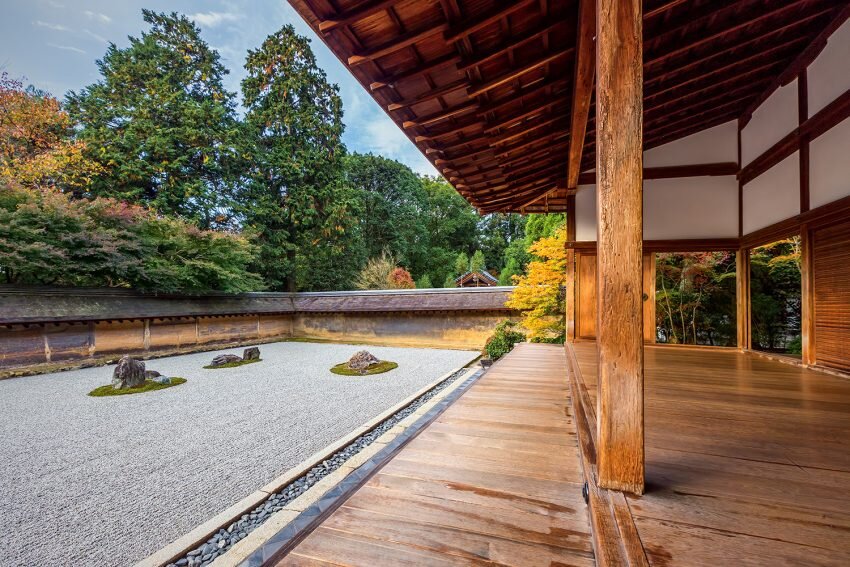
Ryōan-ji Temple, Kyoto, Japan, 1450.
Now, I’ll show you an example of a contemporary office.

Contemporary office. Credit: israel-andrade-YI_9SivVt_s-unsplash
Do you see the difference? I imagine so.
The first transmits a full silence; the second, noise.
From the first, you can see trees and the sky; in the second, you cannot.
The first has gentle natural light; the second has many strong artificial lights.
In the first, you know what time it is; in the second, you do not.
In the first, you feel rooted in the place; in the second, alienated.
At this point, you’re probably thinking something like:
- “Yes, of course, but I don’t want to live in a forest hermitage; I’m not a monk!”
- And then: “I’m scared to live ‘in’ nature; I wouldn’t feel safe.”
- Or: “I understand the images, but adding two plants to the house doesn’t seem to solve the problem.”
And you would be right in all 3 cases!
This is where Biophilia comes in.
What if the real “treatment” for the mind was, first and foremost, the kind of room we put it in?
"Biophilia is not putting a plant in a pot.
It’s designing places that help you return to being human,
when everything else pushes you to become a machine."
What is Biophilia and What is Biophilic Design?
What is Biophilia?
Biophilia is the scientific name for that feeling of “taking off a backpack” when you enter a forest, sit near water, or look at the sky from a window.
“Biophilia is the passionate love of life and all that is alive.”
— Erich Fromm
Biophilia literally means “love for life.”
“Bios” (life) + “philia” (love).
This scientific theory stems from two basic premises:
- as a species, we spent 99.9% of our time in contact with nature;
- the responses that best adapted over time have been encoded in our DNA. (Those who adapted poorly died and remained outside the gene pool).
It is reinforced and transmitted from generation to generation through culture.
Yes, even if you live in a concrete jungle.
Think about it:
- the face of mom and dad, the sound of their voice;
- your breath, the beating of your heart;
- the sky, the rain and its sound when it falls, the sun and the clouds, the wind.
(Someone taught you these things).
Our pattern-seeking brain is “wired” to biophilia from when we are born by the world around us.
But it must be stimulated from childhood to develop its full potential.
Biophilia is “innate,” but not instinctive.
Yet you are right when you say that nature scares you.
Alongside Biophilia, there is also Biophobia (the fear of what is alive).
Two sides of the same coin.
The 3 Levels of Contact
According to the theory, we have 3 levels of contact with nature:
Direct → contact with wild nature.
Indirect → contact with rural/domesticated nature.
Symbolic → contact with images of nature (e.g., images or documentaries).
Level 1 (Direct) is contact with wild nature.
It’s a mix of joy and fear.
But today, none of us would truly be able to survive in a wild environment.
This generates a fear of the unknown within us.
I won’t elaborate further in this Letter.
Contemporary office. Credit: israel-andrade-YI_9SivVt_s-unsplash
Level 2 (Indirect) is contact with domesticated nature.
- Fear decreases.
- The beneficial health effects are maximal.
- This is the level on which Biophilia focuses.
Level 3 (Symbolic) is contact with an “abstract” nature, not present.
- Nature is abstract; we only see representations (drawings, images).
- We are not exposed enough to level 2 (domesticated nature).
- Fear of nature increases.
- The problem is that almost all of our modern life takes place at level 3 (abstract nature).
The Ills of Our Time
The consequences of all this “abstraction” are significant on a mental and physical level:
- sense of disconnection from time and body
- chronic stress and mental overload
- loneliness and social fragmentation
- aesthetic alienation
- indifference towards living things (only theoretical ecology, “nature” is abstract)
But it’s not over. (It’s always darkest before dawn).
It doesn’t just concern us adults.
The pedagogue Richard Louv talks about «nature-deficit disorder»in children.
The results?
More sedentary lifestyles, more anxiety and aggression, more difficulty concentrating, less creativity.
The Cure?
The goal of biophilia is to bring us back to level 2 (domesticated nature).
But what specifically changes in your body when you go from “nature on screen” to “nature in space”?
The effects are significant on various levels.
In recent decades, and particularly in the last 15-20 years, research results have consistently confirmed:
On a cognitive level:
- accelerated attention restoration
- clarity of thought
- greater focus
On an emotional level:
- stress reduction
- reduction of anxiety and depressive symptoms
- faster healing
On a physiological level:
- reduced heart rate
- decreased blood pressure
- greater muscle relaxation
- strengthened immune system
- pain reduction
In practice, biophilia doesn’t solve your life.
But it shifts your basic nervous system from “alarm” to “possibility.”
I’ll be frank; I don’t believe in a “miracle cure” for all the ills of our world.
Life is complex.
It needs to be looked at from many different perspectives.
Biophilia functions as a “basic emotional infrastructure”:
it makes it easier for the nervous system to enter states of calm and openness.
This can enhance therapeutic work, not replace it.
But I have personally experienced the benefits of moving from level 3 to level 2.
If you remember, I told you here that I used to live in an industrial area.
Today I live in a smaller village but with much more countryside around, and I have noticed the benefits on my psyche and physical health.
If all this still seems like “philosophy,” I’ll give you some numbers.
To give you an idea of the effectiveness of this “emotional infrastructure,” I’ll briefly tell you about research conducted way back in 1984.
It’s Not Philosophy: The Ulrich 1984 Case
In 1984, environmental psychologist Roger Ulrich published a landmark study in Science.
He analyzed the medical records of 46 cholecystectomy patients in a Pennsylvania hospital.
All had undergone the same type of surgery in the same ward, in almost identical rooms.
The only difference: the view from the window.
23 patients saw a small patch of trees.
23 patients saw only a brick wall.
The results are impressive:
the “trees” group stayed almost one day less (7.96 vs 8.70 days);
received far fewer negative remarks from nurses (1.13 vs 3.96) (patients were more cooperative, less complaining, and less depressed);
needed fewer strong painkillers, preferring milder ones.
A minimal difference from an architectural point of view – the view from the window – produced a measurable difference in the duration and quality of recovery.
I couldn’t find the original photos.
I’m sharing two images to help you imagine the atmosphere.
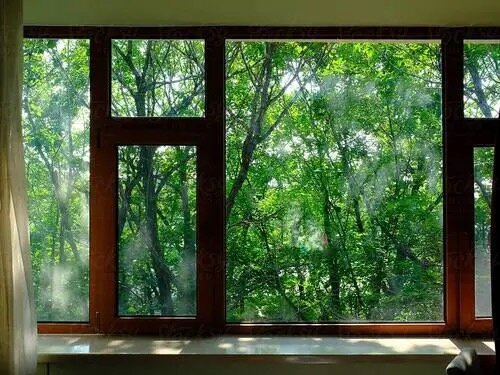
A window with view on trees

A window looking a wall
The effects (including economic) are measurable and, on a large scale, impactful.
Shorter hospital stays, halved strong painkillers...
It’s not decoration; it’s measured physiology.
And we’re only talking about what you see from the window.
Imagine what an entire building designed with these principles can do.
If you were Italian, you might think: “Of course, Nicholas, but it’s no coincidence that hospitals used to be called ‘sanatoriums’ and were up in the hills!”
Here too, you would be right... but then, since the last century, it hasn’t been that way.
This brings us back to our first reasoning about functions, which you can review by clicking on the link here.
In my opinion, this is the authentic spirit of biophilia.
It’s about rediscovering “common sense.”
It’s about scientific discoveries confirming what we instinctively feel but erase with “reason.”
More than discovering the new, biophilia is re-discovering ourselves.
Biophilic Design: Why Two Plants Aren’t Enough
“Biophilic design is the deliberate attempt to translate humanity’s affinity for Nature – known as BIOPHILIA – into the design of artificial environments.”
— Stephen R. Kellert
If biophilia is the theory, biophilic design is the “how-to.”
The goal is to create artificial habitats that safeguard the environment and ensure human well-being.
You’ve already seen a prototype of biophilic design as a child.
It just wasn’t called that.
It was your grandmother’s house.
I’ve been talking about common sense.
Your grandmother’s house was common sense built in bricks.
If you grew up in Italy – especially in regions like Veneto – you probably know the kind of house I mean.
If you didn’t, picture an old farmhouse in the countryside.
Most likely, it had countryside around it, was made of bricks and had the same color as the landscape, it was in a courtyard with a farmyard for chickens, a vegetable garden, fruit trees, a porch with arches.
The bricks were laid and handmade, imperfect; no two were alike!
Maybe it even had geraniums on the windowsills.
Almost certainly, vines grew on the wall, forming a pergola to protect the windows from the summer sun.
It’s not nostalgia.
It’s that, without knowing it, our grandparents were doing empirical biophilia.
Biophilic design:
- is NOT reproducing your grandparents’ house;
- is NOT putting plants everywhere to “beautify” spaces.
Biophilic design:
- answers the question: “How do we reintroduce nature into our cities?”;
- is applied science to create environments consistent with human biophilia;
- is interdisciplinary, a crossroads between:
- Psychology (environmental, evolutionary, social, cognitive)
- Biology (also evolutionary)
- Ecology
- Anthropology
- Architectural and urban design
- Neuroscience
It rests on three fundamental pillars that I will discuss in depth in future Letters.
For now, I’ll name them to give you a preview:
- Nature in the space (views, sounds, water, light...).
- Nature of the space (refuge, prospect, mystery, risk...).
- Analogies with nature (forms, materials, complexity...).
That’s all for this first letter on biophilia.
Biophilia is not a green trend.
It’s the simplest way to stop living like fish out of water, in buildings that have forgotten we are alive.
The question, now, is:
“How could you introduce a little more ‘water’ into your fish life?”
Recapping so far:
Biophilia:
- understands the basic principles behind our “love for life”;
- significantly reduces the “ills” of our time;
- significantly improves our psycho-physical conditions.
Biophilic design:
- applies these principles to build a connection with nature in the spaces of our daily lives.
Here are some examples in sequence to show you what we are capable of doing today by applying biophilic design.
(We’ve made progress since the prototype of grandma’s house).
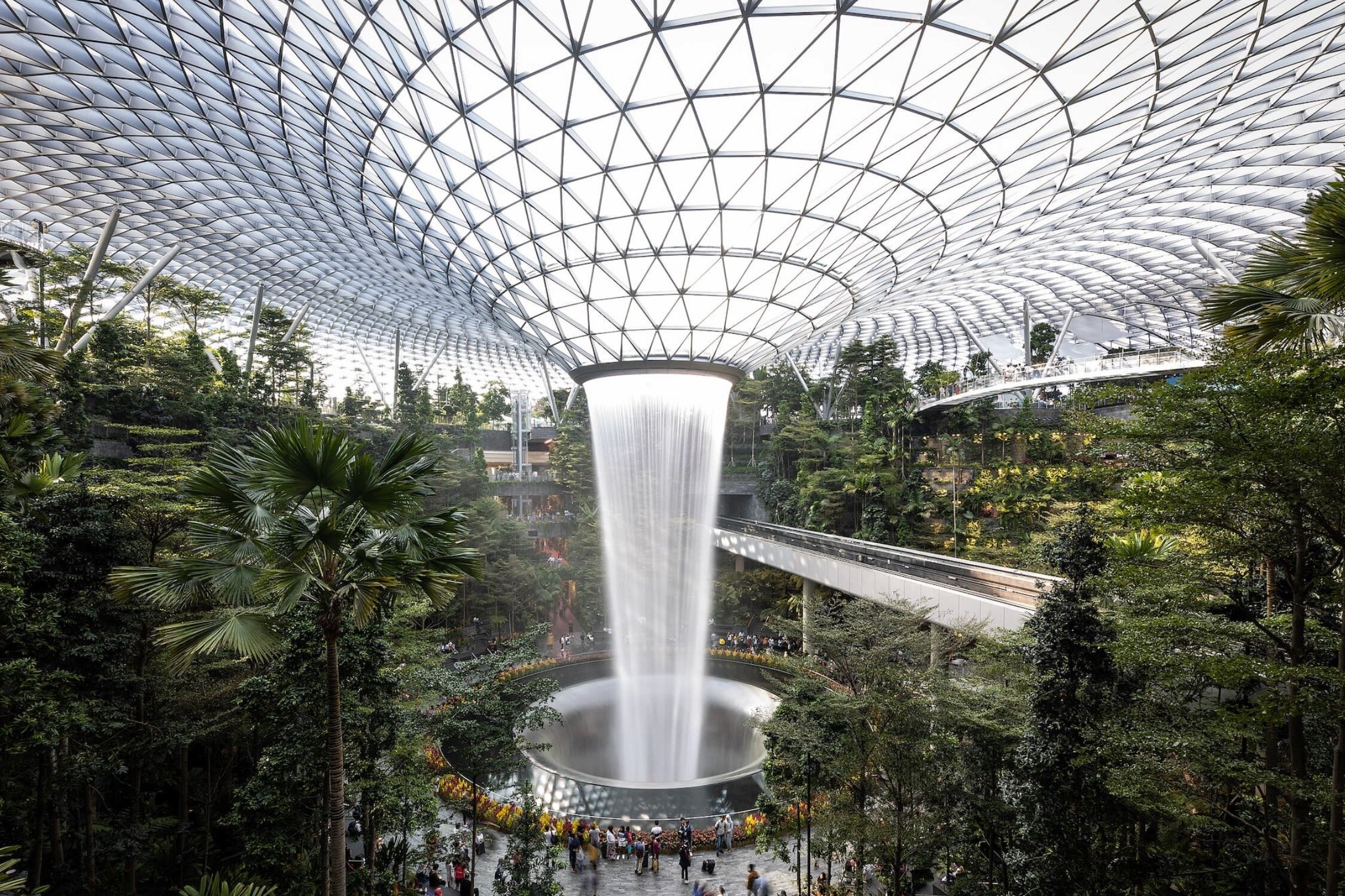
Jewel Changi Airport, Safdie Architects, Singapore, 2019. Photo: Supanut Auronprayote.
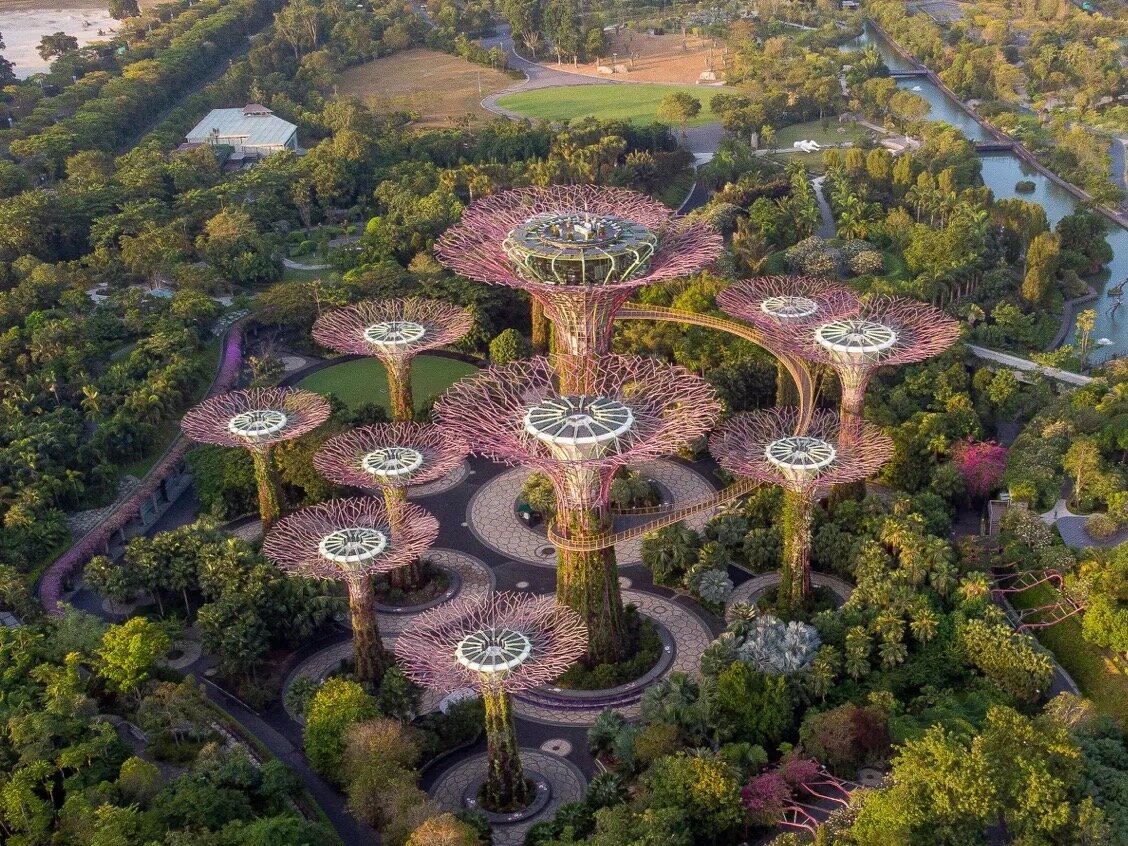
Super trees, Grant Associates, Wilkinson Eyre Architects, Atelier One, Atelier Ten, Singapore, 2012.
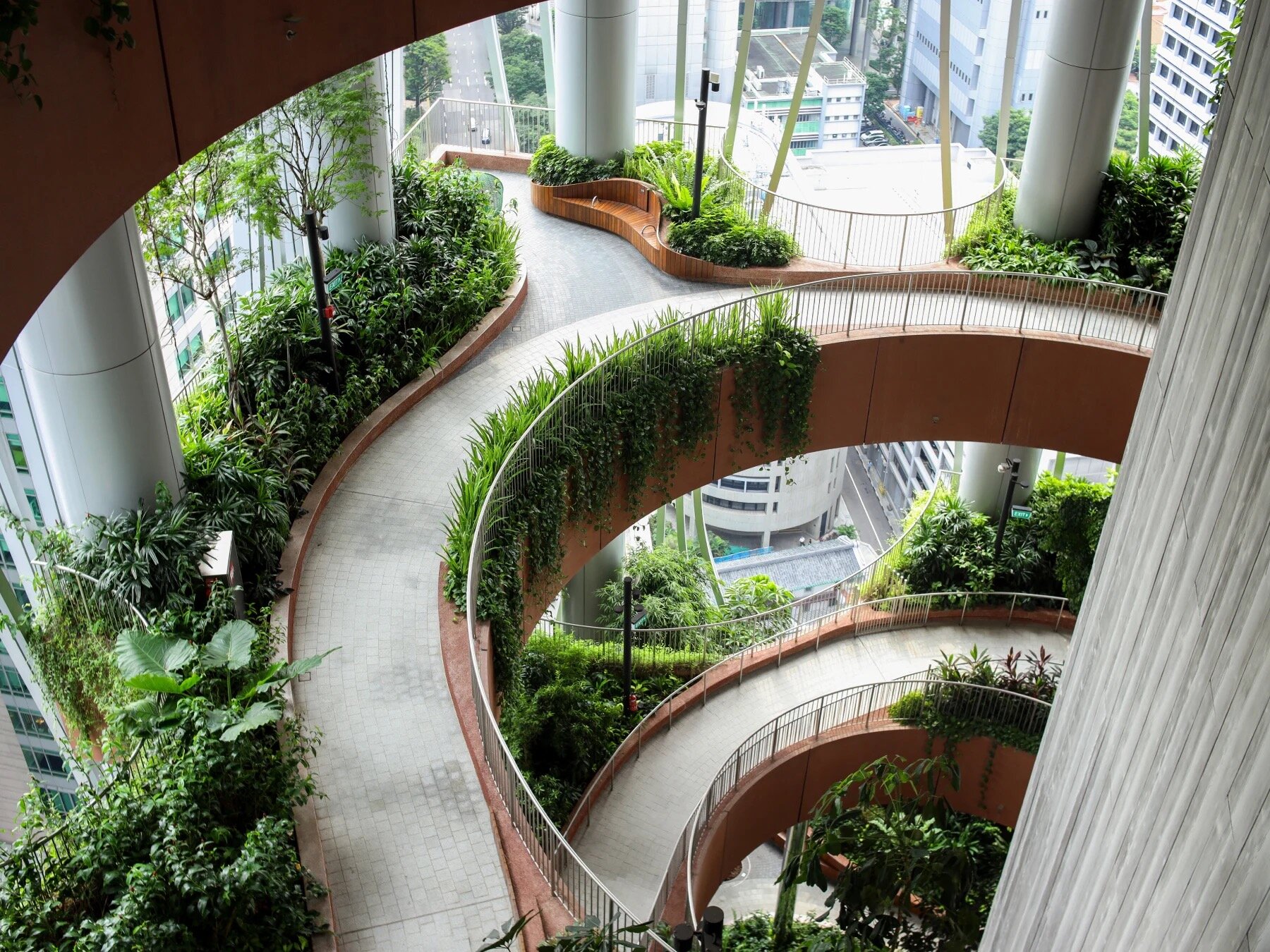
CapitaSpring, BIG e Carlo Ratti Associati, Singapore, 2022.
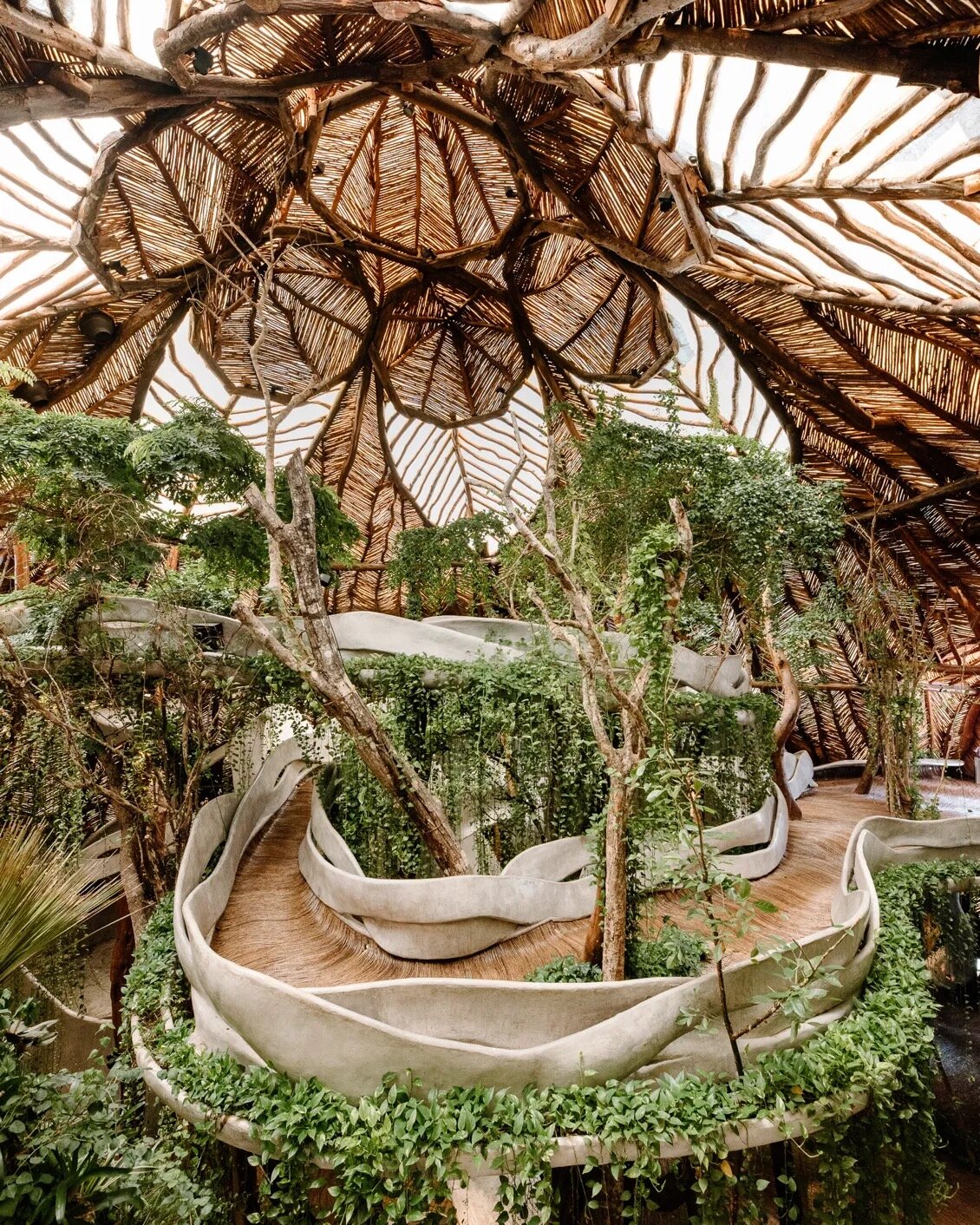
IKLAB Uh May, Roth Architecture, Tulum, Messico, 2018
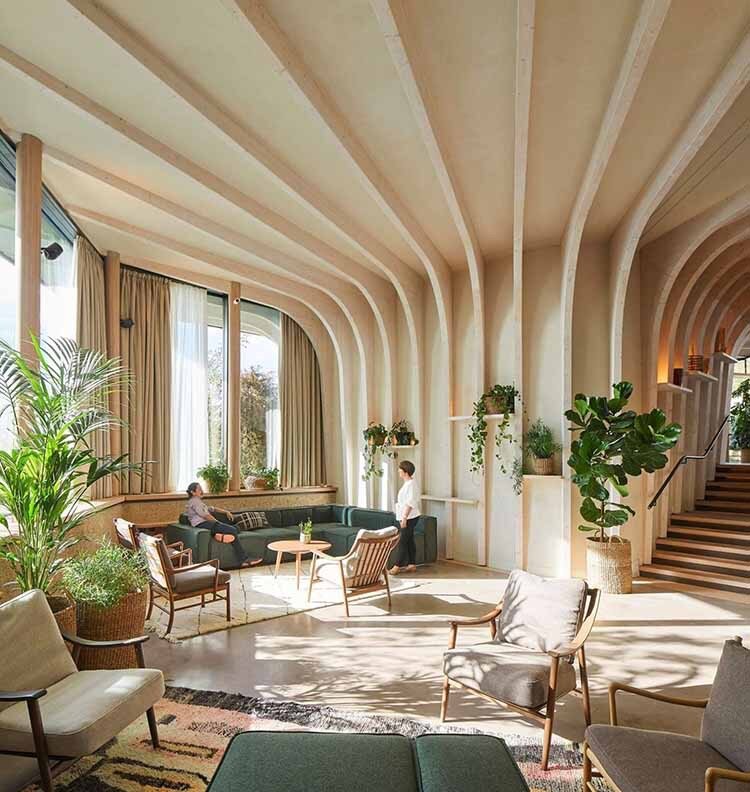
Meggie’s Centre (Cancer Caring Centres), Heatherwick St. James’s University Hospital, Leeds, U.K., 2020.
I hope you enjoyed this brief overview.
If you want to share these images and spread the inspiration that gave to you, click on the “Social” buttons at the end of the post.
If you have any curiosities or are interested in me elaborating further on anything in future Letters, leave a comment down here.
In the meantime,
I hope I’ve given you some food for thought.
I wish you a good weekend.
- Nicholas
P.S.: As you may have noticed, to keep the correspondence more organized for you, I have started dividing the Letters by categories.
This is the first in the Biophilia series.
I hope it helps you stay on track throughout the correspondence.
To introduce Biophilia in your place, you can fill out our «Whisper» to tell us.
It's less tthan 5 minutes.
To read all the numbers without missing them out, apply to the form.
Bibliography:
- Kellert, S. R., Heerwagen, J. H., & Mador, M. L. (Eds.). (2008). Biophilic Design: The Theory, Science and Practice of Bringing Buildings to Life. Hoboken, NJ: John Wiley & Sons.
- Browning, W. D., Ryan, C. O., & Clancy, J. O. (2014). 14 Patterns of Biophilic Design: Improving Health and Well-Being in the Built Environment. New York: Terrapin Bright Green LLC.
- Ulrich, R. S. (1984). View through a window may influence recovery from surgery. Science, 224(4647), 420–421.
- Bolten, B., & Barbiero, G. (2020). Biophilic Design: How to enhance physical and psychological health and wellbeing in our built environments. Visions for Sustainability, 13, 11–16.
- Bolten, B., & Barbiero, G. (2023). Biophilic Design: Nine Ways to Enhance Physical and Psychological Health and Wellbeing in Our Built Environments. In S. Capolongo, M. Botta, & A. Rebecchi (Eds.), Therapeutic Landscape Design (pp. 13–19). Cham: Springer.
- Green Building Council Italia. (2023). CP106_Biofilia – Credito pilota 106 “Biofilia”. Rovereto: Green Building Council Italia.
- Feldman Barrett, L. (2020). Seven and a Half Lessons About the Brain. English translation. New York: Houghton Mifflin Harcourt.
- Louv, R. (2005). Last Child in the Woods: Saving Our Children from Nature-Deficit Disorder. Chapel Hill, NC: Algonquin Books.